



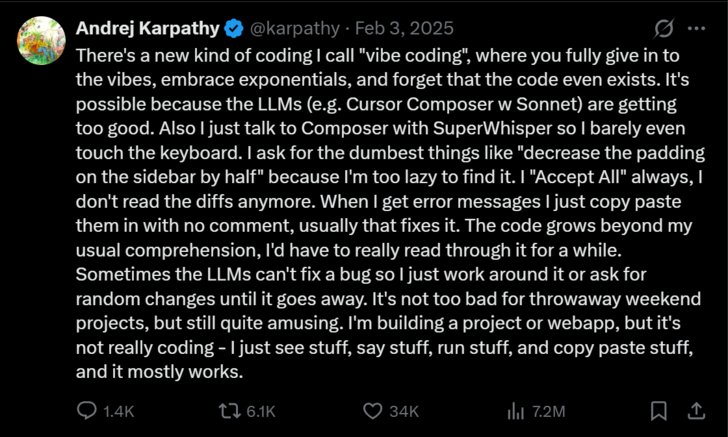

With the AI sector evolving at an incredible pace, we are quickly reaching a turning point: the era of casual, vibe-based coding is set to decrease as AI startups are forced to go public and face Wall Street's financial realities.
What is vibe coding?
For those unfamiliar with the expression — though it is highly improbable for anyone in the tech sector not to have heard of "vibe coding" — it's a term coined by Andrej Karpathy in February 2025 that describes a new way of creating software where you describe what you want to build, and an AI handles the coding.
From that point, the concept was taken over by the entire internet and more and more people started working in this style. Both technical people with programming skills, and many non-technical people who became amazed by how much they could do using an LLM, without coding knowledge.
Why was it possible until now?
Using an LLM to build software is an incredibly resource-heavy operation, even if it looks effortless on your screen. Every time an AI agent generates code, your instructions travel to a massive data center to be processed, which then sends the output back to your device as a continuous stream of text chunks, or "tokens".
As your project grows and the codebase expands, so does the "context window" — the essential background information the LLM needs to analyze in order to deliver highly accurate code that fits your specific requirements.
The bigger the context window, the harder the data center has to work to process your requests. This is because the overall token count — which we mentioned earlier — constantly multiplies as your project accumulates more data.
Right now, casual users aren't billed for the immense processing power they draw. Instead, a flat subscription fee acts like an old-school unlimited phone plan, serving up endless "tokens" for a fixed cost.
This allowed people to exploit AI resources without any limitations. Basically, everyone got a software developer "on the spot", so to speak, for the price of a few dozen euros per month. A deal too good not to take advantage of, right?
The issue of sustainability
Sustainability was never part of the conversation. People were coding without limits, certain that traditional code editors would soon be obsolete. While the world embraced "vibe coding" — with non-technical users building apps via AI — data centers were consuming resources that far exceeded the $20 subscriptions users paid. Investors covered the gap. But profitability remains distant. OpenAI posted $13.1B revenue against $38.5B losses, and the other giants are bleeding cash too.
Real costs
Up to this point, the real costs of artificial intelligence have been settled by investors, as I was saying, and in order to become a profitable business, prices should move from fixed amounts to those based strictly on resource consumption, as happens with any kind of computational resource in the cloud, for example.
Conclusion
If you skipped learning how to actually code because you thought AI would do all the heavy lifting, tough times are ahead.
Don't let the hype from companies selling these tools fool you: the fundamentals of software engineering are irreplaceable.